
The first three months of the 2026/27 financial year have already passed.
For many small business owners, October is a good time to stop and look at how the business is actually performing.
Are sales where you expected them to be? Are your profit margins holding up? Is your cash flow strong enough to cover the next few months? Are your GST, PAYG and super obligations under control?
You don’t need to wait until the end of the financial year to find out.
A simple review now can help you identify problems early and give you time to make adjustments before they become bigger problems.
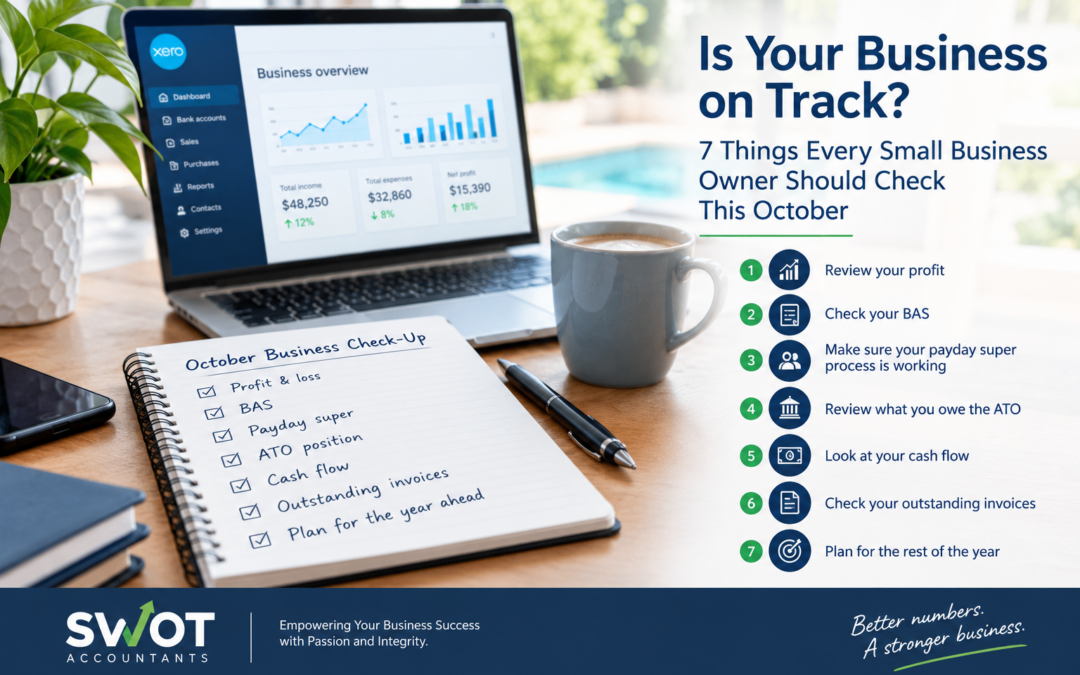
Here are seven things I recommend small business owners check this October.
1. Review your profit for the first quarter
The first three months of the financial year give you a useful indication of how your business is tracking.
Don’t just look at your sales.
Look at:
- Total sales
- Cost of sales
- Gross profit
- Operating expenses
- Net profit
- Whether your profit margin has changed
For example, your sales may have increased by 10%, but if your expenses have increased by 15%, the business may actually be in a weaker position.
This is why looking at the profit and loss report regularly is so important.
If you use Xero, your profit and loss report should give you a quick snapshot of how the business is performing.
2. Check your September quarter BAS before you lodge it
October is also BAS time for many businesses.
Before simply lodging your September quarter BAS, take a few minutes to review the figures.
Ask yourself:
- Does the GST collected look reasonable compared with previous quarters?
- Are all business purchases recorded?
- Are there any unusually large GST amounts?
- Has PAYG withholding been recorded correctly?
- Does the BAS make sense when compared with your actual business activity?
The standard due date for a quarterly BAS for the September quarter is 28 October, although eligible businesses using a registered tax or BAS agent may have access to a concessional lodgement date.
If your BAS result looks significantly different from previous quarters, don’t assume it is correct simply because Xero has calculated it.
It is worth finding out why.
3. Make sure your new Payday Super process is working
From 1 July 2026, Payday Super changed the way employers need to manage superannuation.
Instead of treating super as a quarterly payment that can be dealt with later, employers now need to pay super more frequently, with contributions generally required to reach the employee’s super fund within 7 business days after payday. The new system also requires changes to payroll and STP reporting.
If you employ staff, October is a good time to check that your payroll process is working correctly.
In particular, check:
- Super is being calculated correctly.
- Contributions are being processed after each payday.
- Payments are reaching the employees’ super funds on time.
- Your payroll software is reporting the required information correctly.
- Any rejected or failed super payments are being followed up.
Don’t wait until the end of the financial year to discover there has been a problem with your super payments.
4. Review what you owe the ATO
Your ATO balance should be something you understand, not something you discover when the ATO contacts you.
Check whether you have outstanding:
- GST
- PAYG withholding
- PAYG instalments
- Income tax
- Superannuation liabilities
If you have an ATO debt, make sure you understand how much you owe and when it needs to be paid.
More importantly, if you know you are going to have difficulty paying, don’t ignore it.
The earlier you address a cash flow problem, the more options you generally have to manage it.
5. Look at your cash flow, not just your profit
A profitable business can still run out of cash.
For example, you might have $100,000 of sales recorded but $30,000 of those invoices may still be outstanding.
At the same time, your business still has to pay:
- Wages
- Super
- Suppliers
- Rent
- Loan repayments
- GST
- Other operating expenses
This is why I recommend looking at your cash position as well as your profit.
Ask yourself:
If sales were 10–20% lower than expected over the next few months, could my business still meet its commitments?
If the answer is no, now is the time to do something about it, not when the bank account is nearly empty.
6. Check your outstanding invoices
While you’re reviewing cash flow, take a close look at your accounts receivable.
How much money are your customers currently owing you?
More importantly, how old are those invoices?
There is a big difference between:
- $20,000 of invoices that are due next week, and
- $20,000 of invoices that are 90 days overdue.
If customers are consistently taking too long to pay, it may be time to review your payment terms and invoicing process.
Getting paid on time can make a significant difference to a small business’s cash flow.
7. Start planning for the rest of the financial year
You still have most of the financial year ahead of you.
That means October is a good time to start thinking about what you want the business to achieve between now and 30 June 2027.
Consider:
- Expected sales
- Expected profit
- Cash flow
- Staffing requirements
- Equipment or vehicle purchases
- Business debt
- Tax
- Superannuation
- Upcoming major expenses
There is also an important change to be aware of when considering business asset purchases.
From 1 July 2026, the instant asset write-off limit for eligible small businesses has been permanently increased to $20,000. Eligible assets costing less than $20,000 may qualify for an immediate deduction, subject to the eligibility requirements and simplified depreciation rules.
However, don’t buy an asset simply because you can claim a tax deduction.
The decision should first make sense for your business.
A tax deduction reduces the after-tax cost of an asset, it doesn’t make the asset free.
October is a good time to take a step back
Running a small business can mean spending most of your time dealing with what needs to be done today.
That makes it easy to lose sight of the bigger picture.
The first quarter of the financial year is now behind you. You have actual results to work with, rather than forecasts and expectations.
Use them.
Take the time to look at your profit, cash flow, ATO obligations, superannuation, outstanding invoices and plans for the remainder of the year.
If something isn’t going as expected, October is a much better time to identify it than June.
Need help understanding how your business is tracking?
At SWOT Accountants, we work with small businesses to help them understand their numbers, keep their accounting records up to date and plan ahead.
If you use Xero, we can also help you make better use of your Xero reports and accounting information so you can see what is happening in your business throughout the year—not just when your tax return is due.
If you would like to discuss your business or how your numbers are tracking, contact SWOT Accountants today.